Puppies
Although our focus is on breeding show dogs, as far as we are concerned the primary role of any Cavalier we place is to be a valued family member. It is the same with the dogs we choose to keep for ourselves; they are our pets and our family members first, and show dogs second. When we undertake a breeding we strive to achieve balance in three areas, these being the type (which encompasses conformity to the breed standard as far as aesthetics and conformation), overall health and longevity behind the ancestors, and exemplary temperament. Breeding Champion dogs should be about more than winning blue ribbons! We are dedicated to our Cavaliers and their lifelong well being.
Where our puppies are raised | Information for potential Cavalier families
Why reputable breeders sell on a spay/neuter contract | Puppy buyer etiquette
Where our puppies are raised
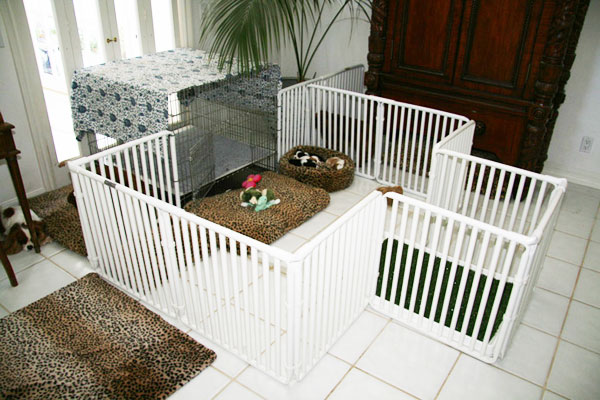
The above is a photo of how I use Rover Enclosure Panels to configure a puppy set-up that works for me. I also use the Right Spot (developed by dog trainer, Teri Hamrick) to aid in the housebreaking of my puppies. All our dogs are part of our family and live in our home.
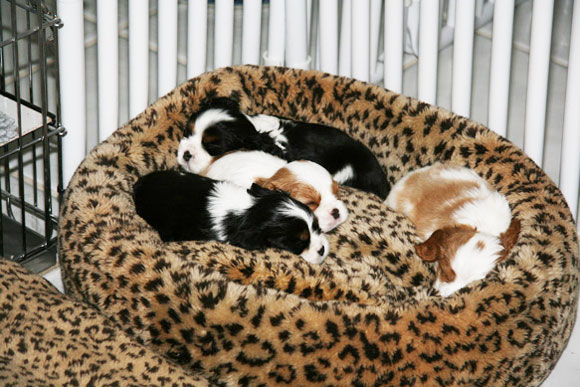
Information for anyone looking to add a Cavalier to their family:
1. Beware of illegitimate registries
In the US, the dog should be registered with the AKC and/or the CKCSC, USA (original, parent club of the breed in the US). Beware of the illegitimate registries like the Rare Breed, Continental Kennel Club, FIC, North American Purebred Dog Registry, Krystle Kennel Club, Dog Registry of America, APR, or others (new ones are always cropping up). Usually these breeders are people who have lost CKCSC and/or AKC privileges or who do not qualify. In Canada, the dog should be registered with the Canadian Kennel Club and in England with The Kennel Club.
2. Do not deal with someone USDA registered.
These are commercial breeding farms, commonly referred to as puppy mills. Do not buy from a pet store. They are almost always supplied by puppy mills, no matter what they say. It is specifically against the Code of Ethics of the CKCSC,USA to sell to a broker or pet store, or to supply a dog for an auction or raffle.
3. Buy the breeder first and then the dog.
You want someone experienced and knowledgeable whom you will be comfortable with for the lifetime of the dog. They should be there to answer questions, help with training, etc. They will want to know of any problems you are having and will require you to notify them if you are unable at any time for any reason to keep the dog.
4. Reputable Breeders ask many questions, be sure you do the same.
Ask where the puppies were raised, what the breeder did to socialize them, what clubs the breeder belongs to, why this particular breeding was done, what are strengths of the dogs, what are their weaknesses. If the parents are not being shown (and winning) how was it ascertained that these are dogs possessing the qualities that favor a good breeding? Make sure the answers you receive resonate well with you; if not keep looking the last Cavalier puppy has yet to be born.
5. Be sure to ask about and see certificates of health testing on parents.
The appropriate ones for Cavaliers are:
Heart: The latest research presented at the International Heart Symposium in May 98 says sire and dam should be at least 2.5 years of age and heart cleared by a Board Certified Cardiologist (ACVIM, Cardiology will appear after the DVM designation) within the previous year. Note that this clearance should not be done by a general veterinarian. Their parents should still be heart clear at age 5. Mitral valve disease is a major concern in the breed
Eyes: Sire and dam should have a current (within the last year) CERF (Canine Eye Registration Foundation) test preformed by a Board Certified Ophthalmologist (Again, this cannot be done by a regular vet).
Patellae: Luxating, or slipping, patellae, or kneecaps, are a common problem in toy breeds, including Cavaliers. Patellas should be checked and certified in writing prior to a dog or bitch being used for breeding. Unlike hearts and eyes, this examination can be preformed by a regular veterinarian. Ideally, this certification will be submitted to and recorded with the OFA (Orthopedic Foundation of America)
Hips: Hip dysplasia does occur in small dogs. Approx. 11% of Cavalier x-rays submitted to the OFA show hip dysplasia and since the really bad ones are never sent in, they estimate as much as one in three Cavaliers possibly has HD. An x-ray is taken by a regular vet and sent to the Orthopedic Foundation for Animals (OFA) for a grading of Excellent, Good, or Fair, or degrees of dysplasia. A regular vet does not read the x-ray; it must go to the OFA for reading. The OFA website has some excellent info and you can check the status on any dog that has passed (assuming the owner has sent in the results).
6. Ask to see the parents.
When you go to look at a puppy or puppies, you should be able to see the parents or at least the mother. If the sire is not present pictures and copies of his health testing should be available for you to view. If the mother is not present be wary you could be dealing with a broker. You will want to be sure the mother has a good temperament as she will influence the puppies more than the father.
7. Know the basics about Cavaliers.
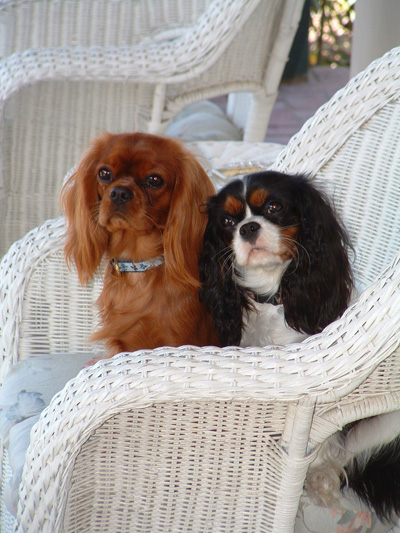 The Cavalier comes in four accepted colors--Ruby (solid Chestnut), Blenheim (Chestnut and white), Black and Tan (black with tan markings), and Tri color (black and white with tan markings). They are 12-13 inches at the shoulder and 12-18 lbs. Cavaliers are indoor dogs. Although they are sturdy and can thrive in both cool and warm climates they are not dogs to be left outdoors. Leaving a Cavalier outdoors when no one is home would put them at great risk both to predators and being stolen. Cavalier puppies do not do well when left all day without human and canine companionship. They are intelligent dogs and require the same consistent and loving discipline as children. Cavaliers do not thrive in situations where they are left alone for long periods of time; remember they were originally bred to be companion dogs. Cavaliers do shed but not in the way that some double coated breeds do. Proper grooming, which consists of regular bathing with a good quality shampoo for dogs and brushing, will keep shedding to a minimum. Lastly, Cavaliers are in your face dogs, they live for kisses and cuddles, if this is not the sort of companion you want, look for another breed.
8. Know when to be cautious.
Red Flags: Statements such as
- "I have any color, male or female available right now."
- "The whole litter is show quality."
- "The testing is not reliable."
- "If you don't trust my word, I don't want to deal with you."
- "My line is free of health problems."
9. Recommended Reading
Cavalier books by John Evans, Bruce Fields, Sheila Smith, Margaret Workman. Other good ones, not specifically Cavalier, are "Puppy Preschool" by John Ross, "Mother Knows Best" by Carol Lee Benjamin, "The Evans Guide To Housetraining" by Job Michael Evans, "How to Raise a Puppy You Can Live With" by Rutherford and Neil.
10. You can expect to pay between $2,200 and $3,000 for a pet quality puppy from a good breeder.
Depending on where the breeder lives it may be slightly more (but not substantially so). Show potential puppies may be more depending on the breeder. Responsible breeders cannot fulfill all of the requests they receive from well qualified homes, hence, you will not see them advertising in newspapers, or on the internet (although they are more than likely listed on breed club breeder referral pages). As has been stated previously, its best to buy the breeder first and then be patient! In the end when you are rewarded with a healthy, well socialized puppy it will be worth having delayed your gratification. For people wanting one of our puppies, being put on our waiting list for just the right puppy is certainly an option, but when waiting does not appeal to a prospective buyer we will be happy to refer them to other equally responsible, conscientious breeders.
11. Contacts
Cavalier Rescue (for a shelter, found, or pre-owned Cavalier) Linda Kornhi at cavlady@mindspring.com. There are also regional chairs. Check out the web sites for the Cavalier King Charles Spaniel Club USA at www.ckcsc.org, or Cavaliers of the West at www.cavaliersofthewest.org .
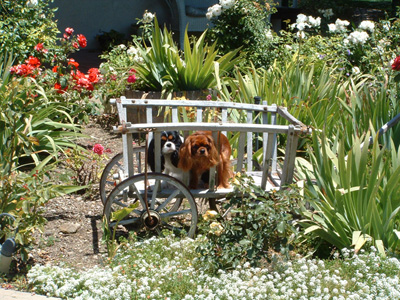 Why reputable breeders sell on a spay/neuter contract
Sometimes people who are buying a puppy want to know if they can breed it when it gets older. They don't understand why the puppy is only available on a spay/neuter basis. Below are some FAQ's that may help to clarify the reasons why a reputable breeder will not allow his or her puppies to be bred. If you find a breeder who sells puppies without a spay/neuter clause, beware. They are almost certainly breeding without regard to the health of the breed.
Q. I am paying a lot of money for this puppy. Why don't I have the right to breed it?
A. The purpose of breeding is to improve the breed. Understanding how to do that takes years of study. It requires knowing what the breed standard is, and recognizing how well any given dog fits the standard and where it falls short.
Breeders who don't take the time to learn the breed standard can harm the look and health of the breed. You only have to look at puppy mill stock to see how much the look can change, even in one generation. Disregarding the terrible problem of breeding dogs with health problems (because they are never health tested), Cavaliers bred without regard to the breed standard can lose the qualities that make them unique, i.e., soft expression, large round dark eyes, small size, long silky coat, etc
Q. What makes a Cavalier worth breeding?
A. Determining the breed worthiness of a Cavalier is both art and science. Breed type, structure, temperament, health and markings are just some of the considerations weighed by an experienced breeder. Much is determined in the show ring, which is the main venue for evaluating breeding stock, and a serious breeder is always involved in showing. There are also health tests the dog must pass to be considered for breeding.
Q. If I start showing the dog, and it passes all the health tests, can I then breed it?
A. It isn't that simple. There is a learning curve that needs to be followed which takes time. Serious breeders have spent years studying the breed, training puppies for the show ring, examining pedigrees and learning from others. That being said, it is possible that the restriction from breeding could be lifted at some point in the future if the puppy buyer meets certain requirements. These would include (but not be limited to) demonstrating a sincere commitment to learning about the breed by:
a) Attending meetings of COTW and the Cavalier King Charles Spaniel Club of Southern California (CKCSCSC) or whatever Cavalier club may be available in your area.
b) Attending the health clinics and seminars that these clubs sponsor
c) Enrolling in a handling class to learn how to show a dog
d) Attending dog shows on a regular basis to either show the dog or just observe
e) Testing for heart, hips eyes and patella's at the appropriate time by the appropriate board-certified specialists to determine if the dog is physically sound enough to be bred.
f) Adhering to the CKCSC,USA Code of Ethics
Puppy buyer etiquette
by Joanna Kimball
I am posting this specifically because I do NOT have any puppies here now, and don’t anticipate any for a while. So you know that I’m not singling any real person out. This is because it seems that there’s a lot of confusion about the whole “proper” way to go about things. So, puppy buyers and anyone else thinking about maybe someday approaching a good breeder about a puppy, here you go:
1) STOP LOOKING FOR A PUPPY. The classic mistake puppy buyers make is saying “I need an xx breed puppy at the beginning of the fall” or whatever it may be. So they go out looking for litters due in August.
BAD IDEA.
Puppies are not interchangeable; one is not the same as the others. This is largely because every breeder has their stop-the-presses criteria for breeding or not breeding, and each has preferences for size, personality, working ability, etc. Breeder X’s “perfect puppy” is not the same as Breeder Y’s.
Stop looking for a puppy; look for a BREEDER. Make a personal connection with a breeder you feel shares your top criteria, and then wait for a puppy from them. Maybe they even have a litter on the ground, which is wonderful, but maybe they’re not planning anything for a few months. Or maybe they’re not planning anything for a year; in that case, ask for a referral to another breeder that shares those same priorities and has a similar (or just as good) personality and support ethic. However it works out, screen the breeder first, then ask about a puppy.
1b) EXPECT TO WAIT FOR A PUPPY. It’s VERY rare to wait less than a couple of months; four to six is normal. I’ve waited a year on a couple of occasions; no, even we breeders don’t walk through the field, able to pick puppies like tulips. We ALL have to wait, and we ALL have to get matched up by the puppies’ breeder.
2) INTRODUCE YOURSELF THOROUGHLY. The initial e-mail should be several paragraphs long; block out at least an hour of quiet for the first phone call. When you initiate contact, clearly communicate three things: You are ready for a puppy, you are ready for a puppy of this breed, and you understand what sets this breeder apart from the others and you share that commitment. Specifically describe your plans for this puppy; be truthful. If you are not going to be able to go to four training classes a year, SAY SO. Don’t say “Of course, training is a huge priority around here,” or you’re going to end up with a puppy who’s flushing your toilet sixty times a day because he’s so bored and you’re not challenging him.
The ideal first contact e-mail usually goes something like “Hi, my name is X and I’m writing to inquire about your dogs. I’ve been doing a lot of research on [breed] and I think they’re the right one for me because of [these four reasons.] I know puppies are a huge commitment, and I am planning to [accommodate that in various ways.] I’m approaching you in particular because of your interest in [whatever,] which is something I feel is very important and plan to encourage in [these three ways.]”
That’s the kind of e-mail that gets a response, and usually pretty quickly. If I get something that says “I hear you have puppies on the way; how much?” it goes in the recyle bin before you can blink.
2a) Bring up price either at the end of the first contact (if it’s been successful and you feel a connection to this person) or in a follow-up contact. It’s nice to say “If you don’t mind me asking, about how much are [breed]s in this area, if there is a typical price? I just want to be prepared.” The breeder will usually give you two pieces of useful information: Her price, and the median prices around you. That way, if you decide to go a different way, you know about what to expect. If the second person you contact names a price that’s double the median, try to discreetly find out why. A very difficult pregnancy, nationally ranked parents, a surgical AI, c-section resulting in very few live puppies, those are some reasons a breeder could be asking more and it’s reasonable. If there’s no real difference from the other breeders except price, think carefully.
3) BE WILLING TO BE TOLD NO. Not every person is the right match for every breed. That’s just fact. There is no way on earth I could make our home appropriate for a Malamute puppy, and I’d have to lie through my teeth to get approved for one. And I have my entire life devoted to keeping dogs happy. I don’t expect you to have anywhere close to the obsession I have, so that means there will be some dogs that are just plain wrong for you. If a breeder says no, ask why. If the answers make sense, don’t keep calling people until you finally get one who will sell you a puppy of that breed. Go back to the drawing board and be very humble and honest with yourself about what kind of dog really would be right for you and your family.
4) PLEASE DO NOT GET ON MORE THAN ONE WAITING LIST unless you are VERY honest about it. This goes back to rule 1. You need to understand that we think our puppy buyers are just as in love with the puppies as we are. We’re posting pictures, writing up instructions, burning CDs, researching everything from pedigrees to nail grinding, all so we can hand off this puppy, this supreme glorious creature of wonderfulness, with the absolute maximum chance that it will lead a fabulous life with you, and we’ve built all kinds of air castles in our heads about how happy this puppy will be, and what it will do in its life with you, and so on. Finding out that you had your name on four lists shows that you don’t realize that puppies are not packages of lunch meat, where getting one from Shaws is basically the same as getting one from Stop and Shop.
Also, as soon as your name is on one of our lists, we’re turning away puppy buyers. If we’ve sent ten people elsewhere because our list is full, and then suddenly you say “Oh, yeah, I got a puppy from someone else,” it really toasts our bread. So just BE HONEST. If someone came to me and said “I’m on a list with So and So, but she’s pretty sure she won’t have a puppy for me, and I’d love to be considered for one of your dogs and I’ll let you know just as soon as I know,” I’m FINE with that. I understand how this goes. It’s not a disaster for me to have a puppy “left over” at eight weeks because you ended up getting that So and So puppy; it’s just frustrating to have the rug yanked out from under me.
5. PLEASE DO NOT EXPECT TO CHOOSE YOUR PUPPY. This one drives puppy buyers CRAZY. I know this, trust me. I have a lot of sympathy because I’ve been there. But the fact is that when you come into my house and look at the eight-week-old puppies and one comes up and tugs on your pant leg and you look at me, enraptured, and say “THIS IS IT! He chose ME,” I’ve been looking at people coming into the house all week, and every single time this same puppy has come up and tugged at them and every single one of them have said to me “THIS IS IT!”
What you are seeing is not reality. You are seeing the most outgoing puppy, or you’ve fallen in love with the one that has the most white, or the one that has a different look from the rest of the litter (when I had one blue girl puppy in a litter of black boys, every human that came in the house wanted her; when I had one black girl puppy in a litter of blue boys everyone kept talking about how much they loved HER), or the one that’s been (accidentally) featured the most in the pictures I’ve posted. Or, sometimes, you have a very good instinctive eye and you’re picking the puppy that’s the best put together of the litter. And that puppy, of course, is mine, and you’re going to have to pry him out of my cold dead hands.
My responsibility is not to make you happy. And that, dear friends, is why I am posting this now, and not when I have a bunch of actual puppy buyers around. But it’s the truth. My responsibility is to the BREED first. That’s why my first priority in placing puppies is the show owners, because they are the ones that will (if all goes well) use this dog to keep the breed going. It’s not that I like them better than I like you; it’s that I have to be extremely careful who I place with them so that they can make breeding decisions with the very best genetic material I can hand them. My second responsibility is to the PUPPY. I will place each puppy where I feel that it has the best chance of success and the optimal environment to thrive.
So while I do care, and I will try to take your preferences into account, do not expect to walk into my living room and put your hand in the box and pick whatever puppy you want. And do not expect to be given priority pick because you contacted me first; conversely, do not expect that because you came along late you somehow won’t get a good puppy. Sometimes the person who calls me when the puppies are seven and a half weeks old ends up with what I’d consider the “pick” for various reasons (sometimes because somebody called me up and said they’d gotten a puppy from someone else; see rule 4 above). I am going to try to do my absolute best to match puppies to owners as objectively as I can, not according to who called first.
When I was waiting for Clue, I think I initially called Betty Ann six months before she was born. I waited through two other litters, where Betty Ann thought she might have something for me but then in the end told me no. Then I waited until 8 weeks when she thought this one might really be the one, and then another two weeks until she made her final picks and sent me a puppy. I was about ready to vomit with the tension. I UNDERSTAND. But the rewards of waiting and being matched with the right puppy are greater than any frustration with having to sit with an empty couch for a few more months.
6) ONCE YOU GET YOUR PUPPY, THERE WILL ONLY BE THAT PUPPY IN THE WHOLE WORLD. If you’ve been sitting around with your fingers crossed saying “Please, Molly, please, Molly, I only love Molly,” and I say “I really think Moe is the one for you,” you’re probably going to feel disappointed. But take Moe and go sit on the couch, and put your finger in her mouth, and realize that she has a really cool white toe on one foot but none of the other feet have white toes, and let her try to find a treat in your pocket, and I guarantee you by the time you’re five minutes out of my driveway Moe will be YOUR puppy. And a year later you may remember that you thought Molly was so pretty, but Moe… well, Moe could practically run the Pentagon she’s so smart, and her face turned out MUCH more beautiful than Molly’s did. And so on.
7) PLEASE FINISH THE ENCOUNTER WITH ONE BREEDER BEFORE BEGINNING ONE WITH ANOTHER. If you end a conversation with me saying “Well, this just all sounds wonderful, and I’m going to talk it over with my wife and we’ll call you about getting on your waiting list,” and then you hang up and call the next person on your list, that’s not OK. If you don’t feel like you click with me, or you want to keep your options open, a very easy way to say it is to ask for the names and numbers of other breeders I recommend. That way I know we’re not “going steady,” and I won’t pencil you in on my list. If you are on my waiting list, and you decide that you don’t want to be anymore, call me AS SOON AS YOU KNOW and say “Joanna, I’m so sorry, but our life has gotten a little crazy and I need to be taken off the puppy list.” And I make sympathetic noises and take you off. If, then, you decide you want to get a different puppy, be my guest. Just keep me apprised and let me close off my commitment to you before you open it with another breeder.
…Which brings us to something that is super important and most puppy people don’t realize:
8 ) EVERY BREEDER KNOWS EVERY OTHER BREEDER. Now of course I don’t mean the bad breeders, but the show breeding community is VERY small and VERY close-knit. If you’ve been on my list for three months, I’ve kept in contact with you, I think you’re getting a puppy from me, I’m carefully considering which one to sell you, and finally I match you with a puppy when they’re eight weeks old, and THEN you e-mail me and say “Sorry, I got a puppy from Arizona, bye,” my instant reaction isn’t going to be “Oh noes!” My instant reaction is going to be “From Jill?” I probably e-mail Jill several times a year, if not several times a month, and I’m probably going to pick up the phone in the next sixty seconds and say, “Did you just sell a puppy to Horace Green from Topeka? Did you know that he put himself on my waiting list three months ago and has been saying all along how excited he is?” And two minutes after that she’ll get a call from Anne in Oregon and Anne will say “Did you just sell a puppy to Horace Green from Topeka? He’s been feeding me lines for eight weeks! I had a puppy ready to go to him next week!”
And we will take your name in vain, Horace Green from Topeka, and Jill will feel bad that she sold you a puppy, and oh the bad words we will say. And Horace Green from Topeka will be a topic of conversation at the next Nationals, and t-shirts will be made that say “DON’T BE A HORACE,” and someone will name their puppy Horrible Horace and everyone will get the joke and laugh.
In the end, “Be excellent to each other,” as Bill and Ted so correctly ordered us, is pretty much the paradigm to follow. If you err, err on the side of this being a relationship, not a transaction. Try to act the way you would with a good friend, not with an appliance salesman. And the ending will be as happy for you as it is happy for us.